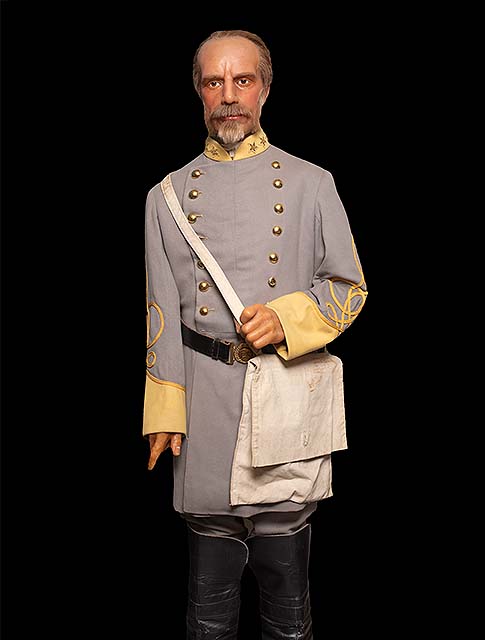
Biography of Joseph E. Johnston
Joseph E. Johnston began his military career early, attending military schools from a young age. A graduate of the U.S. Military Academy at West Point, Johnston was on a quick path to the Army, being appointed second lieutenant shortly after his education. A brave soldier and commander, Johnston saw early action in the Seminole Wars, Illinois’ Black Hawk War, and the Mexican-American War. After much dispute, Johnston rose through the ranks slowly, eventually serving as the Quartermaster General of the Army as a brigadier general.
However, Johnston didn’t hold this title for long, as he would resign his commission after his home state, Virginia, seceded from the Union to eventually form the Confederate States of America. Joining the Confederate Army in the American Civil War, Johnston rose again to serve as the fourth-highest officer in the Confederate chain of command under the rank of full general. In the short-lived Confederacy, Johnston often clashed with President Jefferson Davis, was removed and reinstated to command multiple times. Eventually, his troops would see defeat, and he would surrender to Union forces in early 1865.
Joseph E. Johnston died on March 21, 1891, at the age of 84 in Washington, D.C., from pneumonia. He is remembered for his great military feats, such as helping to secure the first major Confederate victory in the First Battle of Bull Run, but also for his weak offensive tactics and tendency to execute defensive retreats whenever a threat seemed too big. Despite being on the losing side of the American Civil War, Johnston enjoyed a long life, serving on the Virginia delegation in the U.S. House of Representatives for one term and as the U.S. Railroad Commissioner under President Grover Cleveland’s first administration.
DID YOU KNOW?
Johnston is remembered for his great military feats, such as helping to secure the first major Confederate victory in the First Battle of Bull Run.
Interesting Facts About Joseph E. Johnston
Joseph E. Johnston’s mother, Mary Valentine Wood, was a niece of Patrick Henry, a Founding Father of the United States of America and a five-time governor of Virginia.
Johnston was named after his father’s Revolutionary War commander, Joseph Eggleston, who also served in the congressional House of Representatives as a member of the Virginia delegation.
Joseph E. Johnston earned the nicknames “the great retreater” and “retreatin’ Joe” during the Civil War after executing multiple tactical retreats while serving under the Confederacy.
When Virginia seceded from the Union, Johnston was the highest-ranking Army officer to resign his commission.
Joseph E. Johnston’s surrender in April 1865 was the largest single surrender of the war, with 89,270 soldiers.
Early Life of Joseph E. Johnston
Joseph E. Johnston was born on February 3, 1807, near Farmville, Virginia, to parents Peter Johnston Jr. and Mary Valentine Wood. He was the seventh child of nine. His father, Peter, was a Revolutionary War veteran who studied law after the war and eventually became a Virginia judge. In his youth, Johnston attended Abingdon Academy, a military school in southwestern Virginia.
In 1825, Johnston enrolled in New York’s U.S. Military Academy, commonly referred to as West Point, alongside future fellow Confederate general Robert E. Lee. On July 1, 1829, Johnston graduated from West Point ranked thirteenth of forty-six cadets. Following graduation, he was appointed as second lieutenant in the 4th U.S. Artillery, where he would serve for eight years before resigning from the Army in 1837 to study civil engineering. In his first eight years with the Army, Johnston fought in Illinois’ 1832 Black Hawk War.
Serving as a civilian topographic engineer for a warship in the Second Seminole War, Joseph E. Johnston was convinced to rejoin the Army on July 7, 1838, as a first lieutenant of a gallantry unit in Florida. Seven years later, on July 10, 1845, Johnston married Lydia McLane in Baltimore, Maryland. Lydia was the daughter of Louis McLane, a lawyer and politician who served in both congressional houses as a representative for Delaware and later served as the tenth U.S. Secretary of the Treasury and twelfth U.S. Secretary of State. The Johnston couple never had children, despite being married for over 40 years.
Shortly after his marriage, the Mexican-American War broke out. Four months into the conflict, on September 21, 1846, Johnston was promoted to the rank of captain. During the war, in which he saw plenty of action, Johnston was wounded twice, leading him to attain the brevet rank of lieutenant colonel in April 1847 and the brevet rank of colonel five months later.
After the end of the Mexican-American War, Joseph E. Johnston was returned to the rank of captain with the topographical engineers. Over the next several years, Johnston fought this decision, feeling that, despite his promotions being brevet, he still earned the title of colonel and deserved to officially hold that position. On March 1, 1855, Johnston joined the 1st U.S. Cavalry at Fort Leavenworth, Kansas, where he was promoted to lieutenant colonel. Despite seeing a rise in rank, it wasn’t the colonel title he wanted, and Johnston continued to air his grievances.
DID YOU KNOW?
After the end of the Mexican-American War, Joseph E. Johnston was returned to the rank of captain with the topographical engineers.
A few months later, on July 11, 1855, the U.S. Secretary of War, Jefferson Davis, ruled against Johnston’s appeal to become a colonel. This marked the beginning of a heavily strained relationship that would only get worse when they later served together in the Confederacy during the American Civil War. However, three years later, Davis would be succeeded by John B. Floyd, who, as a marital relative of Johnston, reversed Davis’s ruling and promoted Johnston to the rank of colonel. This decision was heavily based on favoritism, but satisfied Johnston nonetheless.
Joseph E. Johnston and the Civil War
On June 28, 1860, Joseph E. Johnston was appointed by the U.S. Secretary of War, John B. Floyd, to serve as Quartermaster General of the Army, which also came with a promotion in rank to brigadier general. Johnston only held this position for ten months, as he would resign his commission on April 22, 1861, five days after Virginia seceded from the Union. This marked the beginning of the American Civil War, which saw conflict between the seceded states forming the Confederate States of America (or the Confederacy) and the Union states over slavery disputes.
After leaving the Union, Johnston briefly served in the Virginia militia before receiving a commission on May 14, 1861, to become a brigadier general in the Confederate Army, relieving Colonel Thomas J. “Stonewall” Jackson of his command in Harpers Ferry, Virginia. There, he raised troops titled the Army of the Shenandoah, leaving for Manassas to reinforce General P. G. T. Beauregard’s Army of the Potomac in the July 1861 First Battle of Bull Run, where they secured the first significant Confederate victory in the war. After the win, Johnston assumed control over the Army of the Potomac, combining the two armies under his command.
A month after the success in the First Battle of Bull Run, President Jefferson Davis requested that the Confederate Congress promote Joseph E. Johnston, Beauregard, Robert E. Lee, Samuel Cooper, and Albert Sydney Johnston to the rank of full general. However, the effective dates of these promotions saw Johnston as the fourth-highest officer in the Confederate chain-of-command, despite holding the highest rank in the old federal army. Johnston felt slighted by Davis’s decision, adding more tension to an already strained relationship. Davis dismissed Johnston’s complaints and held firm in his decisions.
On October 22, 1861, Davis placed Johnston in charge of the Department of Northern Virginia and the defense of Richmond, Virginia. In 1862, Union forces executed their Peninsula Campaign, a large-scale effort to capture the Confederate capital in Richmond. As Union Major General George McClellan’s Army of the Potomac advanced closer to the capital, Johnston defensively retreated up the peninsula closer to Richmond. On May 31, 1862, Johnston engaged McClellan’s troops in the Battle of Seven Pines. Unfortunately, an exploding Yankee shell severely wounded Johnston, forcing him to retire from the field. In his place, Davis ordered Robert E. Lee to take command of Johnston’s troops. The battle was ultimately deemed a draw.
Later that same year, after recovering from his wounds, Joseph E. Johnston was assigned to head the Department of the West, tasked with coordinating efforts between two armies, General Braxton Bragg’s Army of Tennessee and Lieutenant General John C. Pemberton’s Department of Mississippi and East Louisiana. In late 1862, Union General Ulysses S. Grant began a campaign to capture the Confederate stronghold on the Mississippi River. While initially unsuccessful, Grant’s troops began to corner Pemberton’s troops in mid-1863.
Johnston rushed to support Pemberton in Mississippi, but ultimately decided to retreat after seeing the scale of Grant’s force, leaving Pemberton alone to face the growing army. While Johnston advised Pemberton to retreat, President Davis ordered his forces to stay, ultimately leading Pemberton to surrender his troops and the City of Vicksburg to Grant after a 45-day siege. This loss was a devastating blow to the Confederacy, and Johnston took the public blame for it. Davis removed the Army of Tennessee from Johnston’s command and left him in charge of minor operations in Mississippi and Alabama. He wouldn’t return to command until Bragg resigned his post over the Army of Tennessee, with Davis choosing Johnston as a replacement.
However, this return to command was short-lived. In May 1864, Union Major General William T. Sherman launched his Atlanta Campaign. Utilizing similar tactics to those used in the Peninsula Campaign, Joseph E. Johnston continued to give ground to opposing forces. Despite seeing some Confederate victories, Davis grew tired of his weak offensive strategy and extreme caution, which removed him from command in July 1864 and replaced him with John Bell Hood.
After much public clamor, calling for Johnston’s return to command, the newly appointed General-in-Chief, Robert E. Lee, ordered Johnston to assume command of the Army of Tennessee and all troops in the Department of South Carolina, Georgia, and Florida in February 1865. On March 6, 1865, Confederate officials added the Department of Southern Virginia to Johnston’s command. Johnston began to gather his forces in North Carolina to go against Sherman’s mounting forces, but was swiftly defeated in the Battle of Bentonville in the same month. Johnston withdrew and managed to elude capture for an additional month, but eventually surrendered his forces to Sherman at Bennett Place on April 26, 1865, only two weeks after Lee surrendered the Army of Northern Virginia. Both surrenders virtually ended all organized combat in the American Civil War, leading to the Confederacy’s total defeat and subsequent downfall.
DID YOU KNOW?
Johnston eventually surrendered his forces to Sherman at Bennett Place on April 26, 1865, only two weeks after Lee surrendered the Army of Northern Virginia.
Late In Life
After the end of the war, Joseph E. Johnston went on to pursue various business ventures. He was president of a small railroad company until it failed in 1867, and established a successful insurance agency a year later in Savannah, Georgia. In 1874, he published a memoir titled “Narrative of Military Operations Directed During the Late War Between the States”. An attempt to salvage his destroyed military reputation, the book was highly critical of President Jefferson Davis’s leadership over the Confederacy during the American Civil War, refueling the long-standing conflict between the two.
In 1877, Johnston moved to Richmond, Virginia. A year later, he was elected to Congress, where he served under the Virginia delegation in the House of Representatives from 1879 to 1881. After only serving one term in Congress, Johnston decided not to run for re-election. Later, in 1885, he served as the U.S. Railroad Commissioner under President Grover Cleveland’s first administration.
Overall, Joseph E. Johnston enjoyed a long life outside of war, outliving a majority of the Civil War’s general officers. Despite being on opposite sides of the war and suffering defeat at his hands, Johnston developed a friendship with William T. Sherman that lasted until the end of their days. On February 19, 1891, Johnston stood bare-headed while serving as an honorary pallbearer at Sherman’s funeral. Unfortunately, this caused him to contract a severe cold that would quickly develop into pneumonia. Joseph E. Johnston died from pneumonia on March 21, 1891, at the age of 84, at home in Washington, D.C. He is buried next to his wife, who had died four years earlier, at Green Mount Cemetery in Baltimore, Maryland. Despite criticisms against his weak offensive strategies and recurring defensive retreats, he is remembered for his outstanding military achievements in the United States and the Confederate States.
FAQs
What type of leader was Joseph E. Johnston?
Joseph E. Johnston was a good leader, widely respected by the public for his military achievements. However, while seeing some victories in the American Civil War, he was reported as having a weak offensive strategy and bad defensive tactics, as he would often call for retreats when the conflict seemed too great.
Why was Joseph E. Johnston important/famous?
Joseph E. Johnston is most known for his military achievements in both the United States and Confederate States of America. While serving in the U.S. Army, he was promoted to Quartermaster of the Army, serving as brigadier general, and eventually served as a full general under the Confederacy. Johnston also served as a U.S. Congressman and Railroad Commissioner after the war.
What battles did Joseph E. Johnston fight in?
Joseph E. Johnston fought in many battles during the American Civil War, such as in the First Battle of Bull Run, the Peninsula Campaign, the Vicksburg Campaign, the Atlanta Campaign, and the Battle of Bentonville. Johnston also fought in the Seminole Wars, the Illinois’ Black Hawk War, and the Mexican-American War.
How did General Joseph E. Johnston die?
General Joseph E. Johnston died from pneumonia on March 21, 1891. After the American Civil War ended, Johnston developed a close friendship with Major General William T. Sherman, despite having been on opposite sides. Upon Sherman’s death, Johnston served as an honorary pallbearer, where he contracted a severe cold that eventually developed into pneumonia after standing bald in the cold weather.
When did Joseph E. Johnston surrender?
Joseph E. Johnston surrendered on April 26, 1865, to Union Major General William T. Sherman at Bennett Place, North Carolina, after evading capture for a month following the Confederate defeat in the Battle of Bentonville. This surrender came two weeks after Confederate General-in-Chief Robert E. Lee surrendered his Army of Northern Virginia.