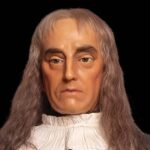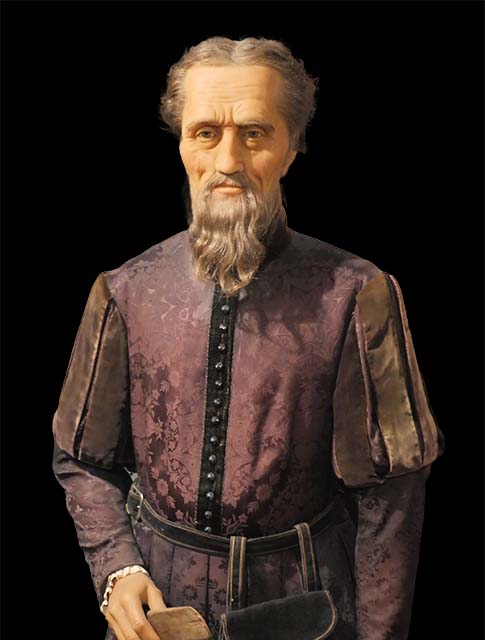
Biography of Michelangelo
From a young age, Michelangelo’s talents as an artist were undeniable. Finding himself in an apprenticeship under Florence’s most popular painter, Domenico Ghirlandaio, it wasn’t long before he caught the attention of Florence ruler Lorenzo de’ Medici, where Michelangelo would fall in love with the art of sculpture under the guidance of sculptor Bertoldo di Giovanni. Growing up in the leading centre of art, Michelangelo became one of the Renaissance greats, weaving Classical and ancient Roman styles into his modern commissions.
A sculptor, painter, architect, and poet, Michelangelo had many different talents. Some of his most notable works include the painting of the Sistine Chapel (the most famous being The Creation of Adam; 1508-1512), the statues Pietá (1498) and David (1501), and the painting Holy Family (1503), which served as an early influence on Florentine Mannerism, an exaggerated version of the High Renaissance style. Considered to have created almost near-perfect technical depictions of the human form, Michelangelo’s art was rich with detail and complex emotion.
Michelangelo di Lodovico Buonarroti Simoni died on February 18, 1564, at the age of 88 in Rome, Papal States (modern-day Italy) after suffering from a brief illness. He is remembered for his stunning depictions of mythological and religious scenes, an outstanding representation of the High Renaissance style of anatomical accuracy and aesthetic harmony. With high ambitions and a vast artistic imagination, the possibilities were truly endless for the great artist, who, unfortunately, left many unfinished pieces of work behind, always eager to move on to new projects he found interesting. Beyond his 88 years of life, Michelangelo has continued to serve as an inspiration for multiple generations of creatives, an endless source of awe and wonder for millions of global travelers eager to witness his artistry. Michelangelo’s legacy is forever cemented among the likes of Leonardo da Vinci, Vincent van Gogh, and Pablo Picasso as one of the most legendary artists in world history.
Early Life
of Michelangelo
Michelangelo di Lodovico Buonarroti Simoni was born on March 6, 1475, in Caprese, Republic of Florence (modern-day Italy), as one of five children to parents Lodovico di Leonardo Buonarroti Simoni and Francesca Neri di Miniato del Sera. For several generations, Michelangelo’s ancestors belonged to a minor nobility in Florence, but unfortunately lost their status by the time Michelangelo was born. His father, Lodovico, had various government jobs and was serving as the administrator of a small town in Caprese, where Michelangelo was born, although the family quickly moved back to their permanent residence in Florence after just a few months.
DID YOU KNOW?
Michelangelo’s ancestors belonged to a minor nobility in Florence.
Early childhood was fairly standard for Michelangelo, who was sent to live with a wet nurse. Tragically, his mother Francesca Neri di Miniato del Sera passed away in 1481 when Michelangelo was only six, the same year that she gave birth to his youngest sibling, Gismondo. Her death was devastating for the family, and it is thought that the loss motivated Michelangelo’s sensitive depictions of women and children in his future art. As he grew older, Michelangelo began to develop an interest in art, although it took work to convince his father to allow him to pursue the craft, which was widely considered to be a major step down in society at the time.
For this reason, Michelangelo became an apprentice relatively late, finding himself under the guidance of Florence’s most popular painter, Domenico Ghirlandaio, at age thirteen. While he was meant to work with the muralist for three years, Michelangelo left after one, his unique talents catching the eye of Florence’s ruler, Lorenzo de’ Medici, or the Magnificent, a generous patron of the arts. The subsequent years that he’d spend in the Medici palatial home surrounded by great scholars and intellectuals, heavily shaped Michelangelo’s views on philosophy, politics, and art. A perk of living under the Medici’s wing, Michelangelo acquired access to his vast sculpture garden, studying pieces such as the highly decorated Roman sarcophagi that were prolific in the collection. This is where he also met the bronze sculptor Bertoldo di Giovanni, a close friend of the Medicis and artistic curator of the garden, from whom he learned much about the art of sculpture. Because of this, Michelangelo considered himself to be a sculptor first, despite his main focus on art and architecture in his notable years. He would later create the Medici marble tomb in their family church of San Lorenzo in Florence.
At the time, Florence was considered the leading centre of art, home to the best sculptors and painters in Europe, including the legendary Leonardo da Vinci and his teacher, Andrea del Verrocchio. While competition was strong, it slowly began to dwindle as artists began to move on to better opportunities outside of Florence, the city struggling to afford the same amount of large commissions it could in previous years. That, paired with the 1494 overthrow of the Medici family, led to Michelangelo’s departure from Florence, choosing to leave the deep political turmoil of his childhood city behind in pursuit of greater feats.
Interesting Facts About Michelangelo
Michelangelo’s mother, Francesca Neri di Miniato del Sera, fell off a horse while pregnant with Michelangelo, which thankfully had no lasting effects on either mother or child.
Michelangelo drew heavy inspiration from Classical art in his early career, finding interest in antiquity and ancient Roman styles of art.
When he was a teenager living under the care of Lorenzo de’ Medici, Michelangelo was punched in the nose by jealous rival Pietro Torrigiano, leaving it permanently disfigured.
Michelangelo created the sculpture Sleeping Cupid (1496), which he purposely aged to appear as an ancient piece. It was then sold as an antique to Cardinal Raffaele Riario, who later discovered the scam and demanded his money back.
One of Michelangelo’s most famous pieces, the statue David (1501), was carved out of a massive marble slab titled “The Giant”, which had originally been slated for the Florence Cathedral, but was ultimately abandoned for forty years.
Michelangelo completed commissions for nine consecutive Catholic Popes, including those between Pope Julius II and Pope Pius IV.
Michelangelo designed military fortifications for the new republican government of Florence after the second expulsion of the ruling Medici family, despite being employed by the Medici Pope Clement VII, who thankfully forgave him for his role in the rebellion.
Both the Pietá (1498) and David (1501) have been victims of vandalism. In 1972, geologist Laszlo Toth took a hammer to the Pietá, breaking off the Madonna’s nose, forearm, eyelid, and veil. It took ten months to repair the piece before it was put on display again behind a layer of protective glass. Similarly, the statue of David was smashed in 1991 with a chisel, breaking off a toe on his left foot.
Michelangelo is represented in multiple works of surviving art, including one bronze bust created by Daniele da Volterra (1564) and two biographies, Giorgio Vasari’s The Lives of the Most Excellent Italian Architects, Painters, and Sculptors (1550, revised in 1568) and Ascanio Condivi’s Life of Michelangelo (1553).
Major Milestones and Accomplishments by Michelangelo
Inspired by the Classical works he studied under Lorenzo de’ Medici’s care, Michelangelo spent the first half of his career preoccupied with antiquity. After leaving Florence, he was hired to succeed a deceased sculptor in Bologna, tasked with finishing the last three marble figures required to complete the tomb and shrine of St. Dominic (1494-95). Following this project, he made a brief return to Florence before going to Rome to produce the Bacchus (1496-97), his first surviving large statue. Focusing on ancient Roman nude figures, Michelangelo was clearly fascinated with mixing modern art and antique styles, going so far as to purposely age a now lost Sleeping Cupid (1496) to appear as if it were an authentic antique piece.
DID YOU KNOW?
Michelangelo was fascinated with mixing modern art and antique styles.
The Bacchus directly led to the commission of one of Michelangelo’s most popular pieces, the Pietá (1498), now located in St. Peter’s Basilica. While it is often presumed that the name refers to the woman depicted in the marble sculpture, it is in fact a reference to the traditional type of devotional image seen in the piece. An image of the Virgin Mary holding her dead son (Christ) mournfully in her arms, Michelangelo’s ability to produce two hauntingly detailed figures from one piece of marble slab was considered to be an extremely difficult task at the time. The Pietá, commissioned by the French cardinal Jean Bilhères de Lagraulas, envoy of King Charles VIII to the pope, heavily boosted Michelango’s career.
His prominence as an artist would only be further cemented by the famed commission of David (1501), a seventeen-foot marble statue of the young David from the Old Testament of the Bible meant to enhance Florence’s Duomo, or cathedral of Santa Maria del Fiore. It is widely considered by scholars to be a nearly perfect technical depiction of the human form (at least, the Renaissance ideal of human form). A great symbol of the Florentine Republic, it was replaced with a copy and moved to the safer Galleria dell’Accademia, where it resides today. In the following years (1501-04), Michelangelo spent his time producing various Madonnas (religious depictions of the Blessed Virgin Mary) for private houses, including the statue Madonna and Child, the relief Madonna and Child with the Infant St. John, and his only easel painting, Holy Family. The Holy Family is especially notable, as it would become an early influence in the development of Florentine Mannerism. This painting is now in the Uffizi Gallery in Florence.
After the success of the Pietá and David, Michelangelo found himself attracted to a wide variety of ambitious projects, although he repeatedly rejected the use of assistants. Overwhelmed with the allure of opportunity and the time demand of commissions, a lot of unfinished work was produced in this time. In 1504, Michelangelo agreed to paint a big fresco in Florence for the Sala del Gran Consiglio alongside Leonardo da Vinci. Two influential figures in world history, scholars often wonder what their interactions looked like during the time they spent together. Both artists depicted a different military victory for Florence (Michelangelo’s was the Battle of Cascina), but both were left unfinished in copies and partial sketches. In 1505, Michelangelo had also begun to work on a set of twelve marble Apostles for the Florence Cathedral, although it was also left unfinished, with only St. Matthew being started.
Both Florentine projects were cut short by the 1505 call to Rome by Pope Julius II, who commissioned Michelangelo to sculpt a grand tomb with forty life-sized statues. With an imagination perfectly suited to Michelangelo’s, the project was set up for greatness. Unfortunately, Pope Julius’s priorities shifted with the construction of St. Peter’s Basilica and his demanding military disputes, leading an unhappy Michelangelo to leave Rome (although he worked on the tomb on and off for decades). He didn’t stay far away for long, though, as the pope pressured Florentine authorities to send Michelangelo back, landing in the pope’s newly conquered city of Bologna to work on a colossal bronze statue, which would later be pulled down by its citizens after driving the papal army out.
Following the construction of the pope’s bronze statue, Michelangelo was tasked with the less expensive project of painting the ceiling of the Sistine Chapel, a sacred part of the Vatican where new popes are elected and inaugurated. While he was meant to depict the twelve apostles, Michelangelo spent four years (1508-12) painting seven prophets and five sibyls (mythical female prophets) around the border of the ceiling, filling the center with nine scenes from the Book of Genesis; three depicting the Creation of the World, three depicting the Adam and Eve, and three depicting Noah and the Ark. One of Michelangelo’s most famous works of art, the most notable painting on the ceiling is the emotional The Creation of Adam, in which God and Adam stretch their hands toward one another.
A major Renaissance man, Michelangelo continued with his art, sculpting Moses (1515) for Pope Julius II’s grand tomb, designing the Laurentian Library in Florence, and painting The Last Judgement (1534). Between 1520 and 1527, Michelangelo dedicated himself to designing the marble interior of the Medici Chapel, made for the untimely death of two young heirs, Giuliano and Lorenzo, who died in 1516 and 1519, respectively. In the Medici Chapel, he carved Day, Night, Dawn, and Dusk, meant to represent the inevitable movement of time, life, and death.
Late In Life
In the 1530s and beyond, Michelangelo began to shift away from sculpture, choosing the less physical forms of painting, poems, and architecture as his mode. Two of his major architectural projects came with Rome’s Capitoline Square and the dome of St. Peter’s Basilica. While he didn’t live long enough to see the completion of either, his design and influence remained in their final forms. Fascinatingly, the artist became engrossed with poetry, incorporating the philosophy of Neo-Platonism (or the idea that a human soul can reunite with God through love and ecstasy) into most of his work. Roughly three hundred of his poems survive today, many of which were dedicated to the poetess Vittoria Colonna. After leaving Florence permanently for Rome in 1534, Michelangelo was also known to write letters to his family, in which he described many attachments to young men, including that of Tommaso Cavalieri. It is unknown if this was a desire for a father-son relationship by a man who never married or had kids, or if it was talk of love.
DID YOU KNOW?
Roughly three hundred of Michelangelo's poems survive today.
As for his sculptures, there were only two that he made in the final decades of his life. Both were made for himself, and both depicted the dead Christ being mourned. The bigger of the two statues was meant for his tomb, while the other was a self-portrait. Unfortunately for the self-portrait, Michelangelo grew very frustrated with the piece, breaking off a finger and abandoning the project altogether. As was on trend for Michelangelo, neither sculpture was finished.
Michelangelo di Lodovico Buonarroti Simoni died on February 18, 1564, at the age of 88 in Rome, Papal States (modern-day Italy) after suffering from a brief illness. He was buried with great ceremony in the Basilica of Santa Croce in Florence. The Pieta he had begun sculpting for his tomb was located close by at the Museo dell’Opera del Duomo. An iconic Renaissance sculptor and painter, Michelangelo is one of the most legendary artists in world history, renowned for his beautiful depiction of the human form in passionate yet subtle displays of complex emotion. Almost five centuries after his death, Michelangelo continues to provide deep inspiration to creative minds and has produced generational wonder and awe for the millions of people who have traveled across the world to get a glimpse of his truly stunning creations.
FAQs
What is Michelangelo most known for?
Michelangelo is most known for being one of the greatest sculptors and painters in world history. His most famed pieces include the painting of the Sistine Chapel (most notably The Creation of Adam, 1508-1512), the statues David (1501) and Pietá (1498), and the painting Holy Family (1503). He was also known as a great architect and poet in the later decades of his life.
How did Michelangelo die?
Michelangelo died on February 18, 1564, at the age of 88 in Rome, Papal States (modern-day Italy) after suffering from a brief illness. While some historians believe he had a fever or some form of kidney-related ailment, records say that he passed quickly in bed, one breath, and then he was gone. Considering the time period, Michelangelo lived a relatively long life.
Why is Michelangelo important?
Born in the time of the Renaissance, Michelangelo became an important figure in bringing Classical styles back into the creative world, favoring ancient Roman styles in his paintings and statues. Considered to have presented a near-perfect technical depiction of the human form, Michelangelo has served as a great inspiration for decades of artists. His painting, the Holy Family (1503), was also critical in the development of Florentine Mannerism, an exaggerated version of the High Renaissance.
How did Michelangelo impact the Renaissance?
In his work, Michelangelo completely revolutionized sculpture with his careful attention to human anatomy, crafting nearly perfect human forms. He also popularized the use of fresco paintings in places of worship, considering his work on the Sistine Chapel. A great Renaissance man, he also had a major impact on the architecture of the time, designing Rome’s Capitoline Square and the dome of St. Peter’s Basilica.
Why is Michelangelo important today?
Besides serving as a great inspiration to generations of artists, Michelangelo not only paved the way for the Renaissance period but also for art as a whole. With his strong attention to realistic and beautiful depictions of the human form, as well as his stunning religious works, millions of people to this date have traveled from across the world to admire his art.