Biography of Frédéric Chopin
Frédéric Chopin is one of the most respected and influential figures in classical music from the Romantic era (1800-1900). He emerged as a defining musical voice, creating piano works that evoked subtle emotion. Frédéric Chopin’s biography explores the contrast of a quiet, fragile man and an expressive pianist. His path from a small Polish village to the artistic salons of Paris showed both remarkable ability and a natural sensitivity to emotion that listeners recognized immediately.
Frédéric Chopin’s music remains an essential part of classical tradition, and Frédéric Chopin works — nocturnes, mazurkas, études, polonaises, waltzes, and ballades — still challenge pianists to balance precision with personality. Rather than focusing only on the pieces themselves, a fuller Frédéric Chopin biography invites us to consider the person behind the keyboard. He was a man shaped by early influences, by love and heartbreak, by national identity, and by the illness that ultimately cut his life short. His legacy, delicate yet enduring, continues to anchor him among the most beloved composers of the Romantic Era.
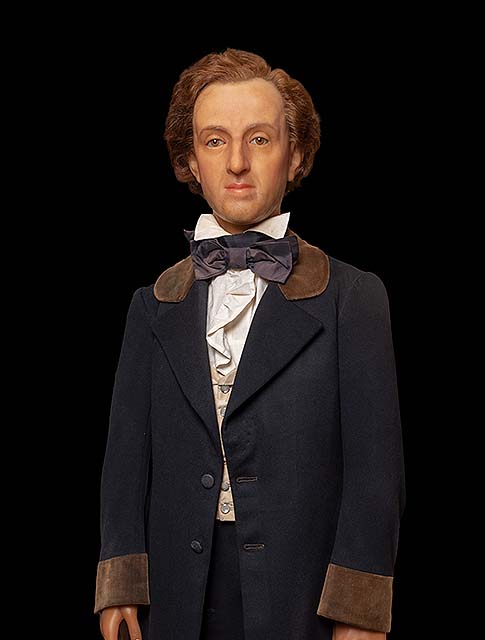
At the Potter’s Wax Museum in St. Augustine, Florida, you will see a lifelike figure of Chopin, full of the spirit of the composer. Some Frédéric Chopin facts include his early prodigious talent, bold innovations for the piano, and a sensitivity to national identity and human emotion. Visiting his exhibit reminds visitors to the St. Augustine museum that Chopin was not just a name on a page of musical history — he was a man whose music still speaks to hearts across generations.
This Frédéric Chopin biography seeks to honor that legacy: to trace his formative years, highlight the major milestones and compositions, reflect on the interesting facts that reveal his personality and genius, and recount how his life’s final years shaped his lasting influence. In doing so, it answers not just who Chopin was, but why his music — and his story — remain timeless.
Early Life of
Frédéric Chopin
Frédéric Chopin’s history begins in March 1810, in the village of Żelazowa Wola in Poland. At the time, this area was part of the Duchy of Warsaw. His birth name was Fryderyk Franciszek Chopin. He was born into a family of modest but cultured background. His father was a French émigré working as a tutor, and his mother was Polish. From infancy, he was drawn to sound. He often listened to his mother and older sister play the piano, which influenced him to attempt to replicate a melody by the age of six.
DID YOU KNOW?
Chopin composed his first published piece at seven years old.
At just seven years old, Chopin composed his first published piece, a Polonaise in G Minor, demonstrating remarkable early talent. By the age of eight, he was performing publicly at charity concerts, captivating audiences with his expressive touch. His childhood was influenced by nurturing guidance and witnessing the political difficulties of the era. The family relocated several times, and Chopin grew up witnessing the political struggles of Poland under foreign control, which would later influence the nationalistic elements in his music.
From 1823 to 1826, Chopin studied at the Warsaw Lyceum, while privately learning piano under the tutelage of Wojciech Żywny. His brilliance quickly outstripped formal constraints, and he absorbed the basics but soon developed an original, expressive approach, marked by sensitivity, lyrical phrasing, and a deeply personal style.
By his late teens, Chopin had already composed polonaises, mazurkas, and other short works inspired by Polish folk rhythms and tradition — early elements that would define his Frédéric Chopin Works. In 1826, he began his formal study under composer Józef Elsner at what would later be known as the Warsaw Conservatory. Under Elsner’s mentorship, Chopin received training in harmony and composition — yet was allowed freedom to develop his own voice.
As political turmoil erupted with the November 1830 Uprising in Poland, Chopin — then a young man of barely 20 — chose exile. He left Poland for Western Europe, traveling first through Berlin and Vienna, before settling in Paris in 1831. Paris became the center of his creative life, a city of salons, émigré communities, and artistic freedom. Here, Frédéric Chopin’s music would bloom fully.
Interesting Facts About Frédéric Chopin
Delving into Frédéric Chopin’s facts reveals a man as intriguing as his music, shaped by sensitivity, innovation, national identity, and humanity.
Chopin published his first composition at age seven and gave his first public concert at eight, marking the start of a lifetime dedicated to piano and composition.
Unlike many composers of his era, Chopin wrote nearly exclusively for solo piano, not for large orchestras. His repertoire includes roughly 61 mazurkas, 26 preludes, 27 études, 21 nocturnes, 20 waltzes, 16 polonaises, four ballades, four scherzos, three sonatas, and many other shorter pieces and songs.
Chopin revolutionized piano technique, including his innovations in fingering, pedaling, and keyboard approach, which changed how the piano was played and perceived. His sensitivity to tone and color made him a master of expressive nuance.
Chopin’s music had the rhythm, melody, and spirit of his homeland, Poland, even though he had not lived there for many years.
Chopin’s social life was a blend of artistry and refinement after he moved to Paris. He became a sought-after teacher and performer in aristocratic salons, favored by wealthy patrons, which was a contrast to the image of a court composer.
His personal life was marked by romantic relationships, including one with the French novelist known as George Sand (Aurore Dupin). Their relationship, though tumultuous and eventually broken, coincided with some of his most creative periods.
These Frédéric Chopin facts underline that, beyond being a legendary composer, Chopin was nationalistic, passionate, and deeply connected to the piano as his voice.
Major Milestones and Accomplishments by Frédéric Chopin
Frédéric Chopin’s biography is defined by a series of achievements that transformed piano music and left a lasting legacy in Western classical tradition.
A New Language for Piano
Although living just 39 years, Chopin’s impact on the piano is immeasurable. He harnessed the instrument’s expressive potential to evoke nuanced emotion, such as tenderness, longing, melancholy, and joy, often within short solo pieces. His études (Op. 10 and Op. 25), preludes, nocturnes, mazurkas, polonaises, waltzes, ballades, scherzos, and sonatas expanded what the piano could express.
His approach to fingering, pedal usage, and tone was revolutionary. Rather than displaying bravura or heavy drama, he focused on poetic subtlety, melodic clarity, and emotional nuance. His works became staples in the repertoire of pianists aiming for expressiveness rather than volume.
DID YOU KNOW?
Chopin's approach to fingering, pedal usage, and tone was revolutionary.
Cultural Bridge: Polish Soul and European Stage
Chopin’s music carried the rhythms and spirit of his native Poland, especially in his mazurkas and polonaises, while simultaneously embracing the cosmopolitan sophistication of Paris. This blend helped introduce Polish musical traditions to European audiences and elevated national identity through art.
In addition, Chopin’s decision to settle in Paris in 1831 placed him at the heart of the Romantic movement. There, he mingled with other composers, artists, and intellectuals by building friendships, sharing ideas, and contributing to the era’s musical evolution.
Teaching, Influence, and Enduring Legacy
Chopin devoted much of his life in Paris to teaching and private recitals, rather than large-scale public concerts. This approach helped him shape a generation of pianists and spread his style across Europe.
Moreover, the body of work he left, which was largely solo piano pieces, has influenced countless composers, performers, and music lovers. His use of harmony, melody, rhythm, and expressive subtlety laid down principles that remain foundational in piano pedagogy today.
Artistic Output Despite Fragile Health
That Chopin accomplished so much in so little time is itself a major achievement. Throughout much of his adult life, he struggled with ill health (later understood to be tuberculosis). Yet even under physical duress, he composed masterpieces that still stir emotion centuries later.
The productivity, inventiveness, and emotional honesty of Frédéric Chopin’s works stand as testimony to his dedication to music, even when life’s circumstances were against him.
Late in Life
The final years of Frédéric Chopin’s life were marked by increasing ill health, solitude, and a tragic sense of decline, and also by creative fidelity to his music. In 1848, he gave his last public performance, playing at London’s Guildhall in a benefit concert for Polish refugees. After that, he returned to Paris, where his decline accelerated.
During these last years, Chopin’s once-active romantic relationship with George Sand had already ended. Personal disappointments and physiological decline combined, and the composer withdrew from society, devoting his final time to intimate circles, teaching, and composition with whatever strength he could muster.
On October 17, 1849, at the age of 39, Chopin died in Paris. His death was attributed to tuberculosis. His body was interred in the famous Père-Lachaise Cemetery in Paris. However, in accordance with his wish (and later Polish patriotic sentiment), his heart was removed, preserved in alcohol, and transported back to Warsaw; a symbolic gesture connecting his mortal remains to his native land.
Today, his legacy lives on through his compositions, teachings, and the countless musicians he inspired. Frédéric Chopin’s exhibit at the Potter’s Wax Museum in St. Augustine features Chopin’s likeness, inviting visitors to reflect on his achievements and the power of music that transcends time.
DID YOU KNOW?
Chopin's death was attributed to tuberculosis.
FAQs
How did Frédéric Chopin die?
Frédéric Chopin died on October 17, 1849, in Paris at the age of 39. His death was attributed to tuberculosis, a disease that afflicted him for years, gradually weakening his health and limiting his ability to perform or compose.
What is Chopin best known for?
Chopin is best known for his solo piano compositions: mazurkas, nocturnes, preludes, waltzes, polonaises, études, ballades, and more. These works defined the expressive and technical possibilities of piano music. Frédéric Chopin’s works remain central to the piano repertoire worldwide.
How many pieces did Chopin write?
Though he lived only 39 years, Chopin composed a substantial body of work, mostly for solo piano. His output includes around 61 mazurkas, 26 preludes, 27 études, 21 nocturnes, 20 waltzes, 16 polonaises, four ballades, four scherzos, three sonatas, numerous impromptus and shorter pieces, plus a few works for piano with orchestra.
Where was Frédéric Chopin born?
Chopin was born in the village of Żelazowa Wola, near Warsaw, Poland (then part of the Duchy of Warsaw), on March 1, 1810. He grew up in Poland, and his early life in Warsaw deeply influenced his musical sensibility and love for Polish folk rhythms.
What were Frédéric Chopin’s last words?
Chopin had a fear of being buried alive. He stated, “The earth is suffocating… as this cough will choke me, I implore you to have my body opened, so that I may not be buried alive.” His sister had executed his wish, including cutting out his heart and returning it to Warsaw, Poland.