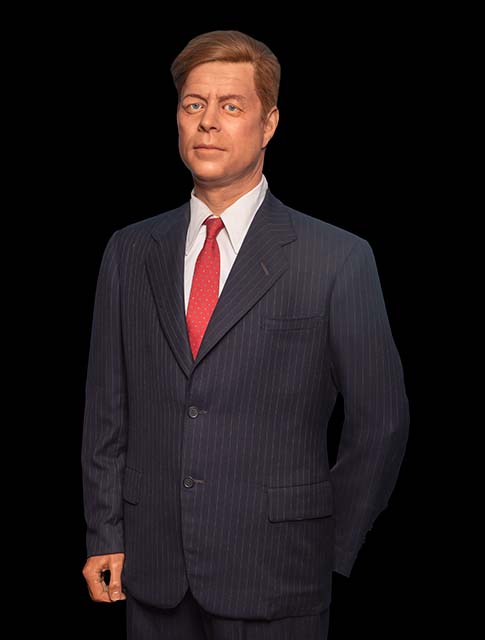
Biography of John F. Kennedy
John F. Kennedy (JKF) began his political career in Congress as a House representative for Massachusetts’ 11th congressional district in 1946. Born into a family with strong Democratic beliefs, the Kennedy family always knew at least one of their children would go into politics. While multiple Kennedy children had successful political careers, none reached as high an office or as much fame as JFK. Alongside his immensely wealthy and involved family, Kennedy found himself on the perfect trajectory to become one of the great leaders of the American nation.
From Navy sailor to congressman and senator, and finally as President of the United States, John F. Kennedy lived his life for his country. With a charming personality and a socialite wife, Kennedy quickly found his way into the hearts of the Americans, the attractive couple taking the nation by storm. A firm believer in civil rights, tax cuts, pay raises, and proper working conditions, Kennedy was a man of the diverse working class of the United States.
John F. Kennedy was assassinated on November 22, 1963, at the age of 46 in Dallas, Texas. Despite only serving half of his term in office as the 35th president of the United States before his untimely death, he is remembered for his major achievements in securing the Nuclear Test-Ban Treaty with the United Kingdom and the Soviet Union, and for establishing the Alliance for Progress with multiple Latin American countries to promote economic growth. A man born for politics, JFK served in both chambers of Congress as a Massachusetts representative for the House and Senate in the years prior to his presidency. He is buried in Virginia’s Arlington National Cemetery under the Eternal Flame, a symbol of everlasting life and national gratitude to honor a great president and a brave veteran.
DID YOU KNOW?
JFK served in both chambers of Congress as a Massachusetts representative for the House and Senate.
Interesting Facts About John F. Kennedy
John F. Kennedy received the Purple Heart for his service in World War II, a U.S. military decoration and honor given to those wounded or killed in action.
Although some were close, JFK never lost a single election, winning every congressional (House and Senate) and presidential position he ran for.
In the 1958 Massachusetts re-election for Senate, John F. Kennedy beat his opponent by 874,608 votes, the largest margin of victory in Massachusetts political history and the greatest of any senatorial candidate that year.
In his acceptance speech after winning the Democratic nomination for the 1960 presidential election, JFK declared, “We stand today on the edge of a New Frontier.” The “New Frontier” phrase would stick with President Kennedy, eventually becoming the nickname of his presidential programs.
John F. Kennedy’s sister, Eunice Kennedy Shriver, founded the Special Olympics, a global sports organization that supports disabled athletes in 32 Olympic-type sports.
The Kennedys’ perfect family image was eventually tainted by allegations that JFK had participated in marital infidelity with motion-picture icon Marilyn Monroe and was associated with members of organized crime.
Early Life of John F. Kennedy
John F. Kennedy was born on May 29, 1917, in Brookline, Massachusetts, to parents Joseph Patrick Kennedy and Rose Elizabeth Fitzgerald. As the second child of nine, JFK was raised in a competitive household influenced by two strong groups – the Roman Catholic Church and the Democratic Party. The Kennedy family was very wealthy, with Joseph Patrick being involved with many prosperous industries and Rose Elizabeth being the daughter of John F. (“Honey Fitz”) Fitzgerald, a onetime mayor of Boston. All nine of the Kennedy children were set up with trust funds to ensure a lifetime of financial independence.
After serving as the head of the Securities and Exchange Commission, Joseph Patrick Kennedy took on a new position as U.S. ambassador to Great Britain. For six months in 1938, JFK served as his secretary, which gave him inspiration for his eventual senior thesis at Harvard University. This thesis, written on the military unpreparedness in Great Britain, was then expanded into his best-selling book published in 1940, Why England Slept.
After graduating from Harvard University, John F. Kennedy joined the United States Navy in the fall of 1941. Two years into his service, he was sent to the South Pacific before being discharged in 1945, the same year World War II ended. Service was not easy for the young JFK, as he was almost killed in battle after a Japanese destroyer sank the patrol torpedo boat he was commanding in the Solomon Islands. Trapped deep behind enemy lines, he led his men back to safety and was awarded the U.S. Navy and Marine Corps Medal for heroism. Unfortunately, his older brother, Joe, didn’t survive the war, leaving their parents’ political ambitions to fall upon JFK, who was then planning to pursue a career in academics or journalism. His family was confident in his success in running for public office, encouraging him to pursue a career that would define the rest of his life and historical legacy.
An unfortunate result of injury in war, Kennedy’s back, which had given him issues since childhood, never fully healed. Despite getting multiple surgeries in 1944, 1954, and 1955, his pain never fully went away. This, paired with a rare autoimmune Addison’s disease, proved to be a painful obstacle that the young president would successfully hide from the public. No amount of pain could keep him from thriving in his political endeavors, a sign of his passion and determination to become a strong leader of his country.
John F. Kennedy’s Congressional Career
In 1946, John F. Kennedy began his political career as Massachusetts’ 11th congressional district House Representative in Congress. Despite his physical weakness after the war, he was an aggressive campaigner, completely bypassing the Democratic organization and relying instead on his family, friends, and fellow Navy officers to secure his win. In the Democratic primary, he received double the votes of his opponent, and in the November election, he beat the Republican candidate by a landslide. JFK was only 29 at the time, a relatively young age for those in high politics.
In his three terms with the House of Representatives between 1947-1953, Kennedy was a strong advocate for improved working conditions and higher wages, lower prices and cheaper rent, and more Social Security for older Americans. When it came to foreign policy, he was an early supporter of Cold War policies, backing the global economic efforts and support offered by the Truman Doctrine and Marshall Plan. However, the House wasn’t enough for the ambitious JFK, who set his sights on Massachusetts’ Senate seat.
In 1952, John F. Kennedy ran against the popular incumbent, Henry Cabot Lodge, Jr., for Senate. To help boost his campaign, his mother and three of his sisters held “Kennedy teas” around the state, garnering thousands of volunteers to help with the campaign, all managed by his 27-year-old brother, Robert. As a result of this family effort, Kennedy beat his Republican opponent by 70,000 votes. A year later, on September 12, 1953, JFK married Jacqueline Lee Bouvier (eventually Jacqueline Kennedy Onassis), a woman twelve years his junior, born to a socially prominent family that boosted his electoral appeal. “Jackie” was considered the perfect complement to the handsome politician, the attractive couple becoming a quick favorite in the public’s hearts. The pair would go on to have four children, Arabella (stillborn, 1956), Caroline Bouvier (1957), John F. (“John-John”) Jr. (1960), and Patrick Bouvier (died a few days after birth, 1963).
DID YOU KNOW?
On September 12, 1953, JFK married Jacqueline Lee Bouvier (eventually Jacqueline Kennedy Onassis)... born to a socially prominent family that boosted his electoral appeal.
As a senator, JFK gained a favorable reputation as being very responsive to constituents’ needs and requests, only going against these wishes when national interest was at stake. In 1954, he was the only New England senator to support President Eisenhower’s reciprocal-trade powers. He strongly backed the opening of the St. Lawrence Seaway, even though no Massachusetts senator or congressman had voted for it in the twenty years before his term.
After Senator Joseph R. McCarthy of Wisconsin conducted witch-hunting campaigns against government workers accused of being communists in the early 1950s, congressional action was taken to condemn his conduct, and a vote was set in 1954. John F. Kennedy faced a dilemma, personally disapproving of McCarthy but also recognizing the support for McCarthy shown by half of his Massachusetts constituents, as well as his own father. When it came time for the vote, everyone expected Kennedy to vote against McCarthy, but found him to be absent instead. While people wondered about his whereabouts, he was in a hospital, left in critical condition after one of his back surgeries.
For six months, JFK had to be strapped to a board in his father’s house in Palm Beach, Florida, stepping away from his duties to focus on recovery. In this time of inaction, he worked on his 1956 Profiles in Courage, an account of eight American political leaders who led by their conscience and defied public opinion. This book would go on to be awarded a Pulitzer Prize in 1957. However, it later came out that, despite being credited as the sole author, it was actually Kennedy’s assistant, Theodore Sorensen, who had done a large majority of the research and writing.
Once back in the Senate, John F. Kennedy began to focus on fighting to abolish the electoral college and establish better labour reform and civil rights legislation. On foreign policy, he worked as a member of the Senate Committee on Foreign Relations in the late 1950s, advocating for extensive foreign aid to emerging countries in Asia and Africa. A surprise to his colleagues, Kennedy even called for France to grant Algerian independence. Slowly, JFK’s popularity began to grow with the Democratic Party, taking his career to new levels as he considered an even higher political ambition: the presidential office.
John F. Kennedy’s Presidential Career
In the 1956 presidential election, John F. Kennedy had almost become Adlai Stevenson II’s vice presidential running mate for the Democratic Party. As a man of great charisma, his near victory in winning the nomination and concession speech to Estes Kefauver introduced him to roughly 40 million American homes. In almost an instant, he became one of the most popular political figures in the country, and his campaign for the 1960 Democratic presidential nomination had already begun. With a few years to win the people’s hearts, Kennedy made a series of speeches, periodical profiles, and appearances on many magazine covers with his beautiful wife, Jacqueline. This calculated pursuit of the presidency in the years prior to the nomination would eventually become the norm for future presidential candidates seeking election.
Again, his efforts were supported heavily by his family, with JFK’s father purchasing a 40-passenger airplane to transport the young politician and his staff around the country, and two of his brothers, Robert and Edward, both highly credentialed individuals, taking on major roles in managing his campaign. It wasn’t until January 1960 that Kennedy would officially announce his presidential candidacy, dominating his Democratic opponents to win the nomination and choosing Lyndon B. Johnson of Texas, his eventual presidential successor, as his running mate.
By a narrow margin of 120,000 out of 70 million cast votes, John F. Kennedy won the general election and became America’s 35th president, barely defeating the Republican candidate, Vice President Richard Nixon, who would later be elected as the 37th president of the United States. With television coming to the rise around this time, it is believed that the four televised debates between the two men contributed to his win, providing millions of Americans with easy access to political material. While both candidates held their own in the debates, Kennedy’s poise and good looks in front of the camera made him the winner to many, in contrast to Nixon’s “five o’clock shadow”. Recognizing the benefits of this new medium, Kennedy would go on to televise his weekly press conferences for the country to watch from the comfort of their own homes.
JFK became the youngest and first Roman Catholic to be elected to the United States presidency, despite the strong religious taboo that no Roman Catholic could ever reach the highest office in the country. With an administration that only lasted 1,037 days, Kennedy set out to make waves, setting his sights on foreign affairs almost immediately. Unfortunately, his first brush with foreign affairs ended horribly. Under Eisenhower’s administration, the Central Intelligence Agency (CIA) had trained and equipped anticommunist Cuban exiles for an invasion of their homeland. The Joint Chiefs of Staff, a panel of high-ranking military officers who advise the president on military issues, advised JFK that by sending them ashore, an uprising against Cuban leader Fidel Castro would spark.
DID YOU KNOW?
JFK became the youngest and first Roman Catholic to be elected to the United States presidency.
This wasn’t the case, as the 1961 Bay of Pigs invasion saw the entire brigade either killed right on the beach or captured, marking a colossal failure for the new president, who bore sole responsibility for the incident. A year later, in the late months of 1962, a foreign crisis would spark again in Cuba when Soviet nuclear missiles were found in the country. President John F. Kennedy quickly called for them to be dismantled and ordered a blockade around Cuba to prevent Soviet ships from landing on the island. For thirteen days, the United States and Soviet Union bordered on war, before the Soviet Premier, Nikita Khrushchev, decided to withdraw all offensive weapons. Ten days later, Kennedy secured his greatest foreign accomplishment when Khrushchev and Prime Minister Harold Macmillan of Great Britain joined him in signing the Nuclear Test-Ban Treaty, banning all nuclear tests above ground.
Due to his narrow win in the 1960 election, JFK was wary of approaching Congress, which was otherwise indifferent to his legislative pursuits. On one hand, it approved his Alliance for Progress to support economic growth in multiple Latin American countries, as well as his Peace Corps, an agency of volunteers built to provide developmental assistance to foreign countries, which was heavily endorsed by thousands of college students across the country. On the other hand, his aspirations to make massive income tax cuts and develop better civil rights measures weren’t passed until after his death. In May 1961, Kennedy also advocated strongly for the space program, declaring that the United States would see a man on the moon before the end of the decade. This was another achievement he wouldn’t live to see either, although his early support was essential to the success of the first American manned spaceflights.
John F. Kennedy was a very popular president, both domestically and internationally. The Kennedy family was a symbol of idealism, optimism, and charm, even beyond JFK’s immediate family. As First Lady, Jacqueline made it her mission to transform the White House into a public museum of American history and culture, going to great lengths to redecorate the space with art and furniture owned by previous presidents. On February 14, 1962, she gave a televised tour of the restored White House, viewed by a record 56 million, winning her an honorary Emmy Award for her performance. She was the perfect partner to Kennedy, a prominent figure on her own, fluent in languages like French, Spanish, and Italian that would help win American favor when she traveled overseas.
Overall, the Kennedy administration was seemingly shaping up to be a great success of progress and peace in both its domestic and foreign affairs. With the support of a strong family and a charming public image that worked wonders for the young president, the American people were set to enjoy what should have been four, and even possibly eight, years of a Kennedy-led nation
Assassination
With plans to run for the presidency again in 1964, John F. Kennedy was sure that his Republican opponent would be Senator Barry Goldwater of Arizona. Confident that he could easily win over Goldwater, Kennedy hoped to receive a mandate for major legislative reforms in a second, but new term. An obstacle was quick to pop up, with Texas Governor John B. Connally, Jr. and Senator Ralph Yarborough developing a sticky feud. In an effort to present a show of unity between the two Democrats, Kennedy decided to tour the state with the two men.
What should have been a simple political move quickly turned into a tragedy. On November 22, 1963, when John and Jacqueline Kennedy were slowly riding in an open limousine through downtown Dallas in a motorcade, the president was shot twice, one in the back of his neck and one in his head. He was rushed to Parkland Memorial Hospital, but was soon pronounced dead after arrival. His assassination, caught on film by Abraham Zapruder, would quickly become one of the most controversial and speculated political murders of the 20th century.
Much happened in the hours and days after John F. Kennedy’s death. Governor Connally, who had been gravely wounded, recovered from his injuries. Vice President Lyndon B. Johnson took the oath as the 36th president of the United States only hours after the assassination, and 24-year-old Dallas citizen and Marine veteran, Lee Harvey Oswald, was arrested for Kennedy’s murder. Two days later, Oswald was shot and killed in the basement of a Dallas police station by Jack Ruby, a local nightclub owner with criminal connections.
Initially, a presidential commission headed by the U.S. chief justice, Earl Warren, found that Oswald had acted alone and was not part of any conspiracy, domestic or foreign, to kill the president. However, the Warren Commission wasn’t able to explain all of the details of Kennedy’s death, and in 1979, a special committee of the House of Representatives found that acoustic analysis suggested there had been a second gunman who had missed. This fueled the growing conspiracies around his assassination, which some still consider suspicious decades later.
DID YOU KNOW?
Vice President Lyndon B. Johnson took the oath as the 36th president of the United States only hours after the assassination.
The Kennedy tragedy didn’t end with JFK, however. Both of his brothers, Robert and Ted Kennedy, would run for president in later years, with disaster striking again in 1968 when Robert Kennedy was assassinated on his campaign trail. In 1999, JFK’s son, John Jr., who had grown into a popular public figure as the founder and editor-in-chief of the political magazine, George, died alongside his wife and sister-in-law when the private plane he was piloting crashed outside of Martha’s Vineyard, Massachusetts. Rumors spread of the Kennedy “curse”, a result of this series of unfortunate tragedies for the large family.
John F. Kennedy is remembered for his charm and passion in his political endeavors. From Navy sailor to president of the United States, his legacy is forever tied to the great nation he worked so hard to defend and lead. After his death, Jacqueline Kennedy Onassis remained one of the most admired women in the country until her death in 1994 from lymphatic cancer, remarrying Aristotle Onassis, a wealthy Greek shipping magnate, and becoming a high-profile book editor after being widowed again in 1975. Both of the Kennedys are laid to rest in Arlington National Cemetery alongside their two infant children, Arabella and Patrick Bouvier, at the Eternal Flame.
FAQs
Where did John F. Kennedy go to college?
John F. Kennedy went to college at Harvard University. While working under his father, the U.S. ambassador to Great Britain, as his secretary for six months in 1938, Kennedy was inspired to write his senior thesis on Great Britain’s unpreparedness for war. This thesis was later expanded into his first best-selling book, Why England Slept, published in 1940.
Where was John F. Kennedy born?
John F. Kennedy was born in Brookline, Massachusetts. A New England boy at heart, Kennedy spent his entire congressional career, both in the House of Representatives and Senate, as a representative for his home state, quickly growing a positive reputation as a politician who responded to his constituents’ concerns and needs over his own personal agenda.
What did John F. Kennedy do?
After graduating from Harvard University, John F. Kennedy joined the U.S. Navy and was awarded for his heroism during World War II. After being discharged, he began his political climb, starting in the House of Representatives before making his way to the Senate, both as a Massachusetts Representative, before finally achieving the highest office in American politics — the presidency. Kennedy was the 35th president of the United States.
What made John F. Kennedy famous?
John F. Kennedy became famous seemingly overnight after his 1956 Democratic presidential nomination concession speech was televised in front of millions of Americans. As a charming and conventionally attractive man, it was no surprise that people were drawn to him, and the rise of television certainly helped in getting his face in front of audiences he might have never reached otherwise.
What was John F. Kennedy like?
John F. Kennedy was a very charming and charismatic man, traits that played a significant role in his quick rise to popularity. While he suffered from years of chronic pain, mainly due to the permanent injuries he sustained while serving in the U.S. Navy and from his rare autoimmune disease, Kennedy never failed to let his passions shine, hiding his pain from the public. He was also considered to be very attractive, which boosted his fame.