The Complete History of Douglas MacArthur
Remembered as one of the most prominent Army Generals in United States history, Douglas MacArthur dedicated his life to the country, serving with distinction in World War I, World War II, and the Korean War. MacArthur was born to a distinguished military family on January 26, 1880, in Little Rock, Arkansas, gifted with a birthright of leadership skills and strategic thinking. Accomplishing numerous military promotions and awards from his starting role as a Junior Officer, MacArthur was destined to become one of the most important figures in World War II.
In his early years, MacArthur gained widespread notoriety for his role as a general in World War I and was awarded the Army Distinguished Service Medal for his service as the 42nd’s chief of staff and commander of the 84th Infantry Brigade. He also achieved the honor of the Army’s youngest major general. MacArthur went on to become one of the highest-ranked Superintendents at the United States Military Academy at West Point, before being assigned the commander of U.S. Army Forces in the Far East at the beginning of the United States’s involvement in World War II. By proving himself in this role, he received the Medal of Honor for his service in the Philippines during the war. After displaying his famous leadership skills in the Pacific Theater, he was promoted to Supreme Commander of the Allied Powers in Japan, where he oversaw the reconstruction of post-war Japan.
MacArthur was later nominated for President of the United States in 1948, though after rejecting the nomination, he was drafted as the commander-in-chief of the United Nations Command at the beginning of the Korean War. He faced controversy and removal over tactical disputes, but remains one of the most beloved and respected generals in the U.S. Army. With a career spanning over five decades, Douglas MacArthur’s biography cannot adequately highlight the impact he had on the Army, as he was one of the most influential military figures in American history.
DID YOU KNOW?
MacArthur was nominated for President of the United States in 1948.
Early Years
Douglas MacArthur was born a military child on January 26, 1880, to Captain Arthur MacArthur Jr. and Mary Pinkney “Pinky” Hardy MacArthur at the Little Rock Barracks in Little Rock, Arkansas. Douglas MacArthur’s early life was surrounded by a military presence; born to a prominent military family, he came from both sides of his family dedicated to serving. His father became known as a hero for his service in the Union Army during the Civil War, earning both the Medal of Honor and promotion to lieutenant general for his actions at the Battle of Missionary Ridge. However, his mother’s brothers — raised in Norfolk, Virginia — fought for the Confederacy. This division of loyalties put a large strain on Pinky and her brothers’ relationship, leading them to refuse to attend their wedding or acknowledge her marriage to Arthur.
Raised alongside his two older brothers, Arthur III and Malcolm, Douglas and his family moved across numerous Army posts throughout the American Old West. The family’s life at the Army posts was primitive, in extremely harsh conditions, which would end up taking Malcolm’s life in 1883 due to a measles outbreak. When Arthur Jr. was posted to San Antonio, Texas, he enrolled Douglas in the West Texas Military Academy, where he excelled in his courses, becoming valedictorian. After seeing Douglas’s success, his father pushed for him to secure an appointment to the United States Military Academy at West Point. He secured an appointment from Congressman Theobald Otjen and graduated first in his class on June 11, 1903. Shortly after graduating, MacArthur joined the 3rd Engineer Battalion as a second lieutenant, departing for the Philippines in October 1903. Due to his dedicated work in the Philippines and surviving an ambush alone, MacArthur was promoted to first lieutenant in April 1904.
After his tour was cut short due to contracting several severe illnesses, Douglas returned to San Francisco, where he was assigned to the California Debris Commission, gaining the position of chief engineer of the Division of the Pacific in July 1905. Later in October 1905, he would be appointed as aid-de-camp to his father, serving with him as they inspected military bases throughout Southeast Asia before arriving back at Fort Mason in San Fransico. After serving as “an aide to assist at White House functions” for a few years at the request of President Theodore Roosevelt, Douglas moved to Milwaukee, shortly before being transferred to Fort Leavenworth in Kansas in April 1908. At Fort Leavenworth, MacArthur was promoted to Captain in February 1911, went on to teach, and was appointed head of the Military Engineering Department and Field Engineer School. Gaining so many achievements in his early years, it is unsurprising that Douglas MacArthur’s biography is a true display of his lifelong dedication to serving the United States.
Personal Life
Douglas MacArthur biographies are typically fixated on his military career and numerous accolades; it is also important to discuss his private life and how he managed a family amid the immense responsibilities and stress of his career. Douglas was known for his charisma and intellectual interests outside of the military, specifically in history and literature. Many of his colleagues recalled how he would wear a Japanese kimono, smoking cigarettes in a jeweled holder while reading for hours in the evening. Between the World Wars, MacArthur also became romantically intertwined with Louise Cromwell Brooks, a socialite and heiress to a wealthy family in Florida. They would get married at her parents’ villa in Palm Beach, Florida, on February 14, 1922.
This marriage caused extreme conflict in his personal life. Douglas’s fellow general, General John Pershing, had previously courted Louise, as well as another colleague to whom she was engaged before breaking off the relationship to accept MacArthur’s proposal. This led to a complete severance of their comradeship, with Pershing even threatening them with exile. In October 1922, MacArthur and Brooks relocated to the Philippines with Brooks’ two children from her previous marriage. After moving back to the States, Arthur was called back to the Philippines alone, leading to a tumultuous separation in 1927 and an eventual divorce in 1929. MacArthur would later meet 37-year-old socialite Jean Marie Faircloth aboard the SS President Hoover in October 1935. They would be married in a civil ceremony on April 30, 1937, and had a son, Arthur MacArthur IV, on February 21, 1938.
DID YOU KNOW?
MacArthur had a son, Arthur MacArthur IV, on February 21, 1938.
Alongside these romantic endeavors, Douglas would maintain a close relationship with his mother, Pinky, throughout his entire life. His mother would frequently refer to him as a “mama’s boy,” and he dedicated himself to her well-being after the deaths of his father in 1912 and brother in 1923. On the same ship that he met Jean, SS President Hoover, his mother grew ill and died in Manila on December 3, 1935. Her death marked him as the final member of his family left, and especially affected him due to their bond. Douglas MacArthur was able to maintain his strength and military prowess despite the immense challenges he faced in his personal life.
Interesting Facts About Douglas MacArthur
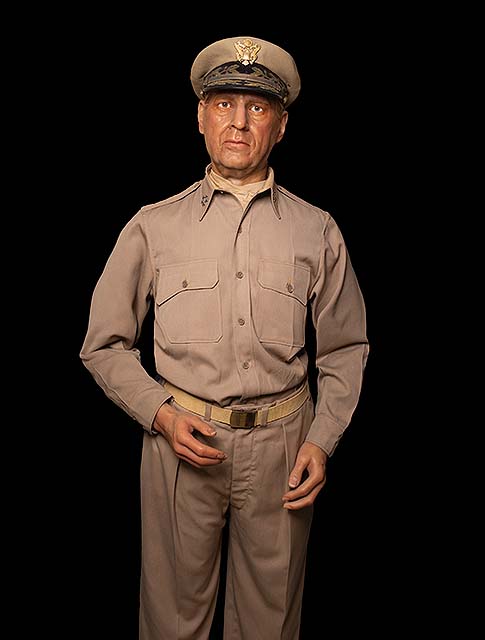
Given his adventurous life spanning three major wars, there are countless noteworthy facts about Douglas MacArthur, his many expeditions, and his immortal legacy. MacArthur left such an impact on the country that his trademark look with a corncob pipe and aviator sunglasses has become a portrait for the United States Army. MacArthur was conscious of his appearance and ensured his look would be both respectable and memorable, even designing his pipe himself with help from the Missouri Meerschaum Company. Such a well-known feature, the company continues to sell replicas of his pipe today.
Alongside his emblematic appearance, a Douglas MacArthur biography is incomplete without highlighting his famous quote, “I shall return,” which became iconic during WWII. He first said the phrase, “I came through and I shall return,” at the Terowie railway station on March 20, 1942, when he was relocated to Australia during the war. This promise carried great weight for those in and out of the military due to its forthright declaration of trust in one’s strength and endurance, and it still serves as a powerful maxim today.
One of his greatest achievements before WWII was serving as the Superintendent of the U.S. Military Academy from 1919 to 1922. He earned this role through numerous promotions and awards from WWI. He then received further awards after WWII, including the Medal of Honor, making him and his father the first father-son pair to both receive the award.
After WWII, he also served as a major symbol of peace and amnesty for his significant role in the reconstruction of post-war Japan and its transition to democracy. He was known for being ahead of his time due to his outspoken progressive beliefs against white supremacy, arguing that Asian countries were not mere “Soviet puppets,” and that all countries needed help recovering. It is also noteworthy to mention that he is remembered as always treating any Filipino and Japanese officials he had correspondence with after the war as equals, showing just as much respect as he would to leaders in the States.
Despite holding such a highly respected stature, Douglas MacArthur was involved in a substantial controversy when he faced removal by President Truman during the Korean War. MacArthur argued against Truman’s strategy of limited war, seeking to expand the conflict into China, leading Truman to relieve him on grounds of insubordination. Removing MacArthur led to a further decline in the nation’s trust in Truman, and several investigations were conducted to determine whether the dismissal was constitutional; however, public support for MacArthur did not waver. MacArthur’s removal could not diminish the respect his name commands as one of the greatest generals in United States history.
What Douglas MacArthur is Known For
Douglas MacArthur had an extensive, noble career and is known for numerous events and accomplishments throughout his lifetime. One of the feats he is best known for is his leadership in the Pacific Theater during World War II and the many accomplishments he achieved as the commander of the U.S. Army Forces in the Far East. He is also famous for his noble actions and governance in his post-war administration of Japan. One of Douglas MacArthur’s most recognized features was his strategic brilliance and charismatic leadership style throughout his career, which both contributed to his success and influence in history. Douglas’s involvement in the Korean War and subsequent dismissal by President Truman are also among his most notable moments, as the controversy caused a decline in Truman’s approval rating, a significant development in his presidency. Douglas MacArthur’s loyalty to the United States and his significant contributions to military strategy and international relationships make him one of the most influential figures in the United States’ history.
Douglas MacArthur’s Military Career
After achieving so many esteemed roles in his early years, Douglas MacArthur’s military career and notoriety grew exponentially during WWII. On July 26, 1941, President Roosevelt called Major General MarArthur back into active duty as a major general, naming him commander of the U.S. Army Forces in the Far East. He became known for his leadership in the Pacific Theater, especially for developing the “island hopping” strategy, Operation Cartwheel, and for his use of combined-arms warfare. These tactics focused on taking over the smaller islands around Japan, rather than delivering a direct hit to the country’s major strongholds, to isolate the power and cut it off from supplies/support. His amphibious and combined-arms strategies were enhanced by integrating the military as a single force through concurrent terrain, air, and naval assaults. The U.S. Navy would go on to award MacArthur for his maritime tactics, granting him the Navy Distinguished Service Medal.
His actions after WWII further exposed his innate sense of leadership through his dedication to rebuilding Japan, both physically and administratively. Shortly after the war, Douglas became Supreme Commander for the Allied Powers. He helped Japan establish a democratic parliamentary system, which would allow its citizens greater individual power and freedom. The constitution he helped craft guaranteed human rights — including supporting women’s human rights, outlawed racial discrimination, and decentralized police and local government. Despite having been at war with them months prior, MacArthur dedicated time to having Japanese citizens meet with the ACLU to be educated on civil liberties and democracy. He maintained power in Japan, rebuilding society and the land until handing power to the Japanese government in 1949.
DID YOU KNOW?
MarArthur helped Japan establish a democratic parliamentary system...
Due to his dedication to his troops, his country, and the state of the world, he was recognized for his charismatic leadership and brilliance as both a general and a government overseer. After the Korean War started on June 25, 1950, the United Nations Security Council authorized a United Nations Command force to assist South Korea, naming MacArthur commander-in-chief. His role in the Korean War would lead to the end of his military career, as President Truman removed him from his post over conflicting strategies. Truman wanted to keep the war isolated to North Korea, but Douglas argued it needed to expand further, specifically against China. In an attempt to pressure Truman to accept his plan, MacArthur mobilized public support and coordinated with other governments to reject the limited-war tactic, which ultimately led to Truman removing him on the grounds of insubordination on April 10, 1951. His release led to mass outrage against Truman, rather than tarnish MacArthur’s reputation. At his farewell address on April 18, 1951, Douglas was interrupted by over 50 standing ovations, while Truman’s approval rating dropped to 22 percent, only nine months after the controversy.
Alongside all of Douglas MacArthur’s achievements as a military leader, he earned the unwavering respect of U.S. citizens and an extensive legacy not to be forgotten. MacArthur will be remembered always for his significant contributions to military strategy and international relations.
How Douglas MacArthur Lived Out the Remainder of His Life
The post-military life of Douglas MacArthur began in 1951, after he retired from the Army following his release from command during the Korean War. Though he was entangled in the controversy that led to his removal, American citizens sided with him and continued to express praise and respect for MacArthur. Douglas arrived back in San Fransico on April 17, 1951, offering a farewell address to Congress two days later. The crowd cheered endlessly for him, showing intense disapproval of his removal. Despite ending his career, MacArthur remained a highly influential public figure, giving many speeches and offering political and military advice. He considered running for president in 1952, but felt uncomfortable campaigning; however, President Eisenhower went on to frequently consult with MacArthur about ending the Korean War. During his later years, he lived in New York City, New York, with his wife, Jean, and son, Arthur IV. When Douglas and Jean returned to the U.S. in 1951, Arthur was 13, yet had never been to the country due to MacArthur’s placements. In MacArthur’s later years, he and Jean lived out the remainder of their lives at the Waldorf-Astoria Hotel while MacArthur earned a $68,000-a-year pension (the equivalent of $643,000), leading lavish, peaceful lives. On April 5, 1964, Douglas MacArthur died of primary biliary cholangitis at the Walter Reed Medical Center in Washington, D.C., aged 84. Douglas MacArthur is remembered as one of America’s most distinguished and controversial military leaders, leaving an immortal legacy.
FAQs
What were Douglas MacArthur’s major achievements during his military career?
Douglas MacArthur’s major achievements during his military career included serving as a distinguished member in three wars (WWI, WWII, and the Korean War), becoming the country’s youngest major general, and serving as the Supreme Commander for the Allied Powers, where he oversaw the reconstruction of Japan and its administration. He was best known for his role as commander of the U.S. Army Forces in the Far East in the Pacific Theater during World War II, where he developed numerous influential strategies and tactics.
How did Douglas MacArthur impact American military strategy?
Douglas MacArthur impacted American military strategy by introducing tactics such as “island hopping,” Operation Cartwheel, and the implementation of amphibious/combined armed warfare. His ideas pulled focus away from direct attacks on enemies’ main headquarters, concentrating on occupying surrounding territories to cut them off from supplies and additional support.
What are some controversies associated with Douglas MacArthur?
The most controversial aspect of Douglas MacArthur’s career was his removal from his position during the Korean War by President Truman. He was insubordinate, attempting to gain internal and foreign support against the President’s order to maintain a limited war. MacArthur’s arrogance also led to a controversy surrounding his early Philippine defense, ignoring warnings to properly prepare against the Japanese, which led to catastrophic defeat and loss of island territories. He was known for his arrogance and disregard for higher authorities.
What role did Douglas MacArthur play in post-war Japan?
MacArthur was appointed Supreme Commander for the Allied Powers, leading the reconstruction of post-war Japan’s infrastructure, economy, and government administration. He developed a new constitution for the nation, shifting away from monarchical control and implementing a parliamentary system in its place.
What is unique about Douglas MacArthur’s leadership style?
Douglas MacArthur’s leadership style is unique due to the charismatic autocracy he maintained in his troops. Though he was direct and refused disobedience, he was able to inspire his men and form loyalty and confidence. He was also a brilliant strategist, developing new and unexpected tactics that others initially doubted.